The District of Pesé is a district that is part of the Province of
Herrera in Panama.

Place
names
Pesé is a small town located in the district of the same name.
Previously it is believed that Pesé comes from the name of a cacique or there
is also the idea that it is from an indigenous dialect originating in Panama,
which is commonly attributed to the cane or stick that people in the interior
of the country use to beat either the sancocho or any other food made in large
cauldrons with the use of firewood.
Pesé has been of great importance since the time of the old republican
life, since it is considered as the first head of the province of Herrera to
later be transferred to Chitré for reasons still unknown, although it is said
that it was due to technical and political processes of the time.
According to a law established in the Republic of Panama, Pesé under the
denomination of head town and the jurisprudence of the district of the same
name is founded on September 12, 1855.
Pesé is a meeting place for all the districts that make up the province
of Herrera, as it has a connection with the sister districts of Chitré, Ocú,
Los Pozos, Parita, Las Minas and Santa María.

Territorial
organization
It is made up of eight townships:
·
Pesé
The district extends over a valley that is part of the Azuero Peninsula,
located in the central area of Panama. According to the latest census, the
district has 12,471 inhabitants, of which 2,750 belong to Pesé cabecera.
Pesé is located 4 hours from Panama (city), 20 minutes from Chitré and
also 20 minutes from the Ocú District. The temperatures oscillate between 24
and 35 ° C, during the year.
There is a chain of hills that surround the District of Pesé, the three
best known are El Común, La Bandera and La Cruz.
These hills are easily accessible and have a panoramic view of the Pesé
Valley. The Cerro El Común, is located at the entrance of the Pesé Valley (from
Chitré); The Cerro de La Cruz, west of Pesé; and El Cerro La Bandera, the
highest of the three, located to the southwest.

Tourism.
Pesé currently brings with it a powerful growth in tourism, supported by the existing relationships that the Varela Hermanos company has with international media. It is important to mention that tourism has grown because with the very popular Rum Route, in Pesé it has awakened the development of different tourist themes, since the so-called route makes a permanent visit to the Museum or better known as the colonial house of the family. Varela, and then by means of carts transported by bulls, guide them along the path of the route until reaching the very popular Hacienda San Isidro, where the work and process of obtaining the Seco Herrerano is shown in different sectors, and then ending in the Barriles Room to taste different types of rums and taste delicious dishes
 .
.
It is also important to mention that there are different aquatic
complexes such as: Roka`s Lakes, Camino Real Aquatic Center and El Pedregoso
aquatic complex. Where for 10 years they have been growing in popularity and
fans, becoming an important means of entertainment in the district and the city.


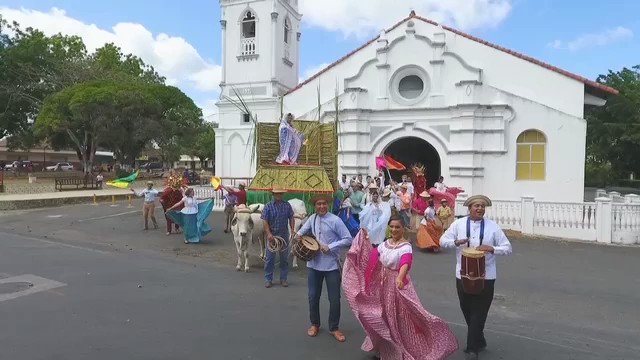
Church of San José in Pesé.
Living Holy Week: every year a staging of the passion, death and
resurrection of Jesus Christ is performed as part of the activities of Holy
Week. At least 150 people take part in this drama that has taken place since
1954 and attracts the eyes of locals and visitors. It is a religious activity
that has been called "Living Holy Week" and that began with the
arrival of the priest José Luis Angulo to the San José de Pesé parish. It was
1954 when the priest, after observing that the parishioners had talents for the
theater, proposed to do a dramatization of the Stations of the Cross at Easter.
At first it was not thought of including the main character of Jesus, because
there were doubts about who could represent him, but finally the young Domingo
Guillén was encouraged to do so.
The activity was gaining more popularity year after year, to the point
that visitors from other regions already know that this drama takes place in
Pesé and they come to see it.
A Merry Christmas Dream, held in December of each year in order to unite
Pesenses families through activities in the Aristides Arjona Park.
Patrons of San José
Patrons of Santa Ana
Sugar Cane Festival
District Festivities, takes place in the month of September when the
District of Pesé was founded.

Monuments and Historical
Buildings.
Among the main historical monuments are:
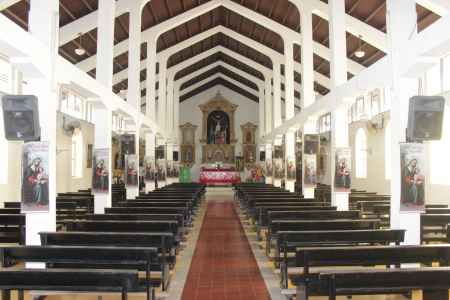
- San José de Pesé Church (founded in 1927).
- Museum of the Varela family.
- Colonial House Villa Apolonía built in 1858.
- Former Herrerana Distillery.

Economy.
It is based on agribusiness, mainly on the cultivation of sugar cane for
alcoholic beverages and the cultivation of corn.
Within the trade sector we can highlight the existence of warehouses,
pharmacies, restaurants, butchers, hardware stores and construction materials,
agro-veterinary, furniture and white goods, jewelry stores, mini supermarkets,
bakeries and refreshments, shops, sales of vegetables and fruits and liquor
companies etc.
In the Pesé district there are important companies such as:
Varela Hermanos S.A founded in 1908 by the immigrant José Varela. Where
it began with the obtaining of sugar for later and after the idea of its
children they turned it into a company that produces alcoholic beverages until
today. The company has the factory in the center of the city and also owns a
farm called Hacienda San Isidro where alcohol is made to be bottled in the
factory, this farm is located on the outskirts of Pesé.
Alcoholes del Istmo S.A.
Campos de Pesé S.A.
There are also other companies dedicated to different manufacturing
processes, such as:
AGLOW, dedicated to the bottling of purified water.
Be San Carlos; located in the Corregimiento of Las Cabras, it is the
first company in Panama to produce ethanol.
Among the most popular drinks we have in Pese districts is cane juice or better know as guarapo. talking about tradicional food Corn torrejitas better known as Pastelitos: It is a fried dessert made
mostly of corn.

